Want more visitors to your website without spending a fortune? For small businesses in Canada, driving traffic is about using smarter strategies, not bigger budgets. Here’s a quick look at 10 practical ways to boost your online presence and attract more customers:
- Optimize Your Google Business Profile (GBP): A free tool that can massively increase local visibility and website visits.
- Use Local SEO: Focus on location-specific keywords and directories to attract nearby customers.
- Create Keyword-Rich Content: Write helpful, targeted content that aligns with what your audience is searching for.
- Leverage Social Media: Share content and engage with your audience on platforms like Facebook and Instagram.
- Run Targeted Social Media Ads: Affordable ads with precise targeting can drive traffic quickly.
- Invest in Responsive Web Design and SEO: A fast, mobile-friendly site ensures visitors stay and convert.
- Try Google Ads: Pay-per-click ads deliver fast results for high-intent searches.
- Build Backlinks with Guest Posts: Write for other sites to improve rankings and drive traffic.
- Improve Site Speed: Faster websites rank higher and keep visitors engaged.
- Track Analytics: Use tools like Google Analytics 4 to monitor what’s working and refine your strategy.
These steps focus on long-term results while being cost-effective. Start with free tools like Google Business Profile and local directories, then gradually expand into content creation, SEO, and ads for steady growth. Remember, results take time, so consistency and tracking are key.
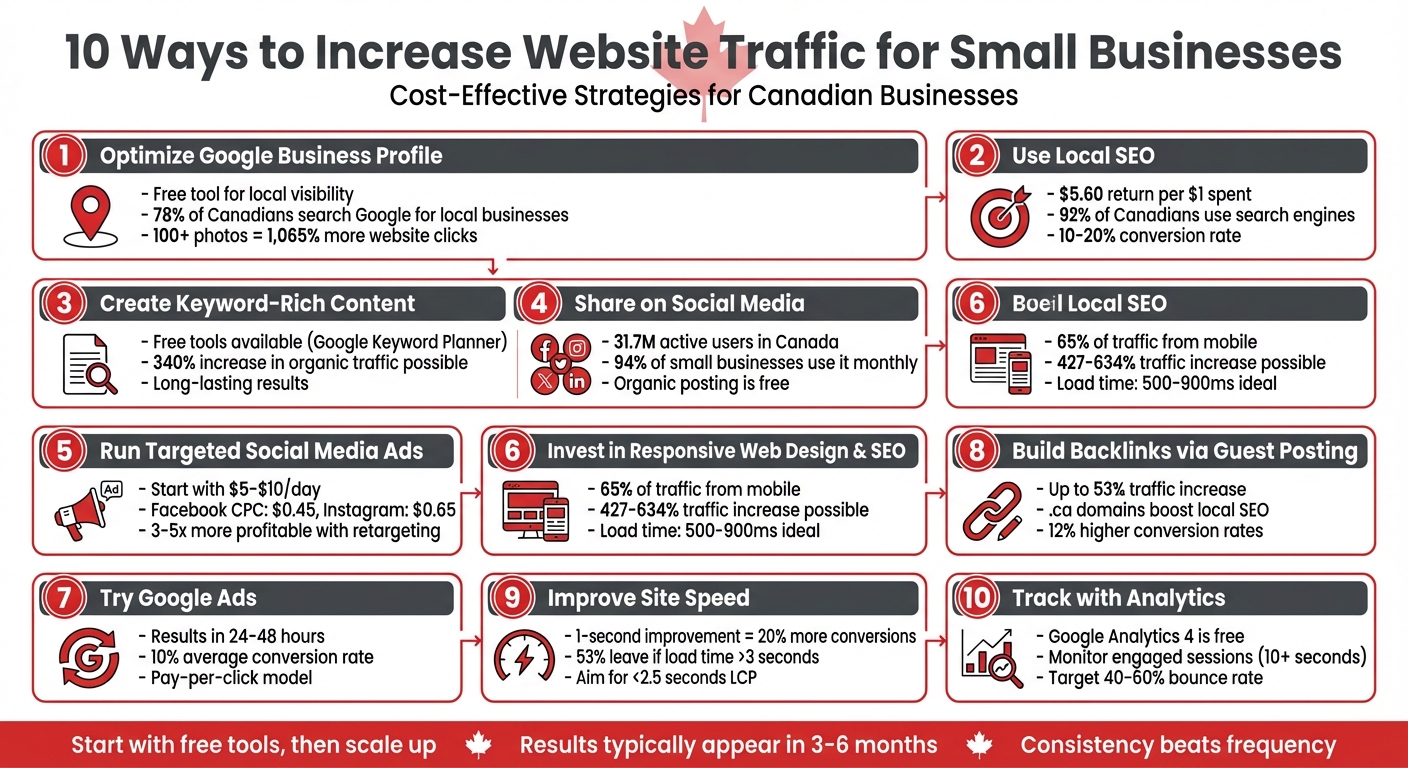
10 Ways to Increase Website Traffic for Small Businesses in Canada
1. Optimize Your Google My Business Profile
Affordable Marketing for Small Businesses
Your Google Business Profile (GBP) is completely free, making it an ideal marketing tool for small businesses. Think of it as a 24/7 digital billboard that promotes your business to local customers without adding to your expenses.
Boosting Website Traffic
Did you know that 78% of Canadian consumers start their search for local businesses on Google? A well-maintained GBP can lead to about 200 interactions per month, with nearly half (48%) resulting in website visits. Businesses that upload over 100 photos can see website clicks skyrocket by as much as 1,065% compared to those with fewer visuals.
Take Troy, a personal trainer from Ontario. In 2025, he updated his GBP, and the results were astounding. His listing jumped from rank #24 to the top 10 for his main keywords. This visibility brought in 23 new clients, boosting his monthly revenue by $4,600 and adding an estimated $55,000 annually.
Simple to Set Up, Even for Beginners
Creating and managing your Google Business Profile is easy, even if you're not tech-savvy. Start by claiming your listing, verifying it (usually via a postcard from Google, which takes 5–14 business days in most Canadian cities), and filling out every field. Jean-François Monfette, a Digital Marketing Specialist at BDC, emphasizes:
"Fill in every field you see. The more information you provide, the easier it is for Google to match your business to the right searches."
To get the most out of your profile, ensure your NAP (Name, Address, Phone) details are consistent, upload 2–4 high-quality photos monthly, ask for reviews after service, and, if you're in bilingual markets like Quebec, include descriptions in both English and French. These small steps go a long way in building trust with Canadian consumers.
Perfect for Canadian Small Businesses
A whopping 83% of Canadian consumers read Google reviews before deciding on a local business. They use your GBP to check your hours, look at photos, and read feedback, often forming their first impression of your business right there.
Google's algorithm prioritizes proximity, which means your small neighbourhood shop can outperform larger national chains in local search results. As Monfette aptly states:
"Unless you're a well-known brand, if you're not on the Google map, you don't exist."
This local focus gives Canadian small businesses a valuable opportunity to stand out and compete effectively in their communities.
2. Use Local SEO Techniques
Affordability for Small Businesses
For Canadian small businesses working within tight budgets, local SEO is a game-changer. It offers an impressive return of $5.60 for every dollar spent. Compared to traditional advertising - where costs can soar above $1,500 per month with conversion rates hovering around 1–2% - local SEO is far more budget-friendly. Typically, it costs between $500 and $1,000 CAD monthly and delivers conversion rates of 10–20%. Even better, many foundational tactics, like listing your business on platforms such as Yellow Pages Canada, 411.ca, or CanadaOne, are completely free. All it takes is your time to set them up properly. This combination of affordability and effectiveness makes local SEO a smart investment for small businesses looking to grow.
Effectiveness in Increasing Website Traffic
The numbers speak for themselves: 92% of Canadians use search engines to find local businesses, and 68% do this at least once a week. Smartphone users are especially active, with 76% of local searches leading to a visit, and 28% resulting in a purchase [21,22]. Google has even reported a massive 500% increase in "near me" searches, reflecting the growing demand for immediate, local solutions. For context, cities like Toronto and Montreal generate millions of local searches monthly - 2.3 million and 1.8 million, respectively. These stats highlight the enormous potential for businesses to attract highly motivated customers through local SEO.
Ease of Implementation for Non-Technical Users
One of the best parts about local SEO? You don't need to be a tech wizard to get started. Start by ensuring your business's NAP (Name, Address, Phone number) details are consistent across your website, Google Business Profile, and Canadian directories [17,24]. Next, include location-specific keywords naturally in your website content. For example, instead of just "plumber", try phrases like "emergency plumber in Surrey" or "bakery in downtown Toronto" in your titles and headers [25,27]. If your business serves multiple neighbourhoods, consider creating separate pages for each area with unique, localized content. These straightforward steps make local SEO approachable for any small business.
Relevance to Canadian Small Business Needs
Local SEO offers an edge that’s especially valuable for Canadian small businesses: proximity can outweigh size. By focusing on their specific area, neighbourhood shops can outrank larger chains. For businesses in Quebec or those serving French-speaking customers, using bilingual SEO - incorporating both English and French keywords - is crucial for reaching the right audience. Additionally, Ontario businesses see 34% higher engagement rates, while Quebec benefits from 31% greater local search visibility. With 88% of local mobile searches leading to a call or visit within a week, local SEO doesn’t just drive traffic - it attracts customers ready to make a purchase. By tailoring strategies to their communities, small businesses can stand out, connect with nearby customers, and turn searches into sales.
Every Way To Get Traffic To Your Website In 2026 [Step-by-Step]
3. Create Quality Content with Keywords
Using targeted keywords in your content isn't just about improving local SEO; it's also a powerful way to strengthen your online visibility.
Affordability for Small Businesses
Creating keyword-rich content is a cost-effective strategy, especially for small businesses. You can get started for free with tools like Google Keyword Planner to check search volumes and AnswerThePublic to find out what questions your audience is asking. If you need more advanced features, paid tools are available at modest monthly fees. For those who prefer outsourcing, Canadian SEO experts typically charge between $75 and $100 per hour, while full-service agency packages average around $3,500 per month. The best part? Quality content offers lasting benefits - well-written pieces can keep attracting visitors for months or even years.
Effectiveness in Increasing Website Traffic
Optimizing content with the right keywords can lead to significant traffic growth. A great example comes from 2025, when iWEBAPP helped AMEQ Academy, a Canadian aesthetics academy, overhaul its online strategy. By focusing on keyword optimization, AMEQ Academy achieved a 340% increase in organic traffic, slashed its bounce rate by 89%, and boosted conversion rates by 280%. These results highlight the importance of ranking well on Google - after all, only 0.63% of users ever click to the second page. As Jason Serafica from Jelly Academy puts it:
Keyword research is the backbone of SEO. The goal is to understand the terms your potential customers use when searching for your products.
Ease of Implementation for Non-Technical Users
You don’t need to be a tech wizard to create effective, keyword-driven content. Start by identifying 20–50 keywords that align with your customers' needs. Validate these terms using free tools like Google Keyword Planner or Google Trends. Focus on long-tail keywords - specific phrases such as "emergency plumbing services Markham" or "digital marketing courses for small businesses Canada." These terms face less competition and often attract customers ready to make a purchase.
When writing, naturally place your main keyword in the H1 header, meta description, and URL. Avoid keyword stuffing; instead, use a conversational tone and clear formatting, like concise headers, short paragraphs, and bullet points, to make your content easy to read. These simple steps not only improve user experience but also help search engines better understand your content. For Canadian businesses, tailoring your content to local audiences can further boost engagement.
Relevance to Canadian Small Business Needs
Localized content is especially effective for Canadian small businesses, as it builds trust and connects with local audiences. Use Canadian English spellings like "favourite", "optimise", and "colour" to resonate with readers. Incorporate location-specific keywords, such as "marketing Toronto" or "coffee shop in Vancouver", to target regional searches. If you’re aiming for Quebec or French-speaking customers, bilingual content can help expand your reach.
Here’s why it matters: 76% of nearby smartphone searches lead to an in-person visit within 24 hours, and 28% of those visits result in a purchase. As Jean-François Monfette, Senior Advisor at BDC, explains:
If you provide the most relevant and helpful content, it has more chances of landing at the top of the results page.
4. Share Content on Social Media
Promoting your content through social media is one of the easiest and most cost-effective ways to drive traffic to your website. With over 31.7 million active social media users in Canada and an internet penetration rate of about 95%, the potential reach is immense. In fact, 94% of Canadian small businesses use social media for marketing at least once a month, with over half posting daily. Plus, organic posting on major platforms doesn’t cost a dime. This makes social media a perfect addition to your overall digital marketing strategy, helping you generate organic traffic without breaking the bank.
Affordable for Small Businesses
When combined with local SEO and high-quality content, sharing on social media can significantly expand your reach. For small businesses, this method is especially appealing because it’s budget-friendly. Organic posts are free, and if you want to explore paid advertising, you can start small - with as little as $100–$200 per month or even daily budgets of $5–$10. Tools like Canva for creating graphics and CapCut for video editing allow you to produce professional-looking content without needing design expertise. Ian McGavin, Founder of Strataigize Marketing, offers this advice:
Small businesses shouldn't try to be everywhere at once. Pick one or two social platforms and own them, your audience will reward focus and consistency.
Boosting Website Traffic Effectively
Social media is a proven driver of website traffic. Canadian businesses have seen triple-digit sales growth and increased event attendance through targeted posts and small-budget ads. Visual content, in particular, tends to perform well, generating 2–3 times more engagement than text-only posts. Platforms like YouTube (81.9% usage), LinkedIn (61.6% penetration), and Facebook (59.1% usage) are especially popular among Canadian users, offering a chance to reach diverse audiences.
Easy to Use, Even for Beginners
You don’t need to be tech-savvy to succeed on social media. Start by focusing on 1–3 platforms where your target audience is most active, rather than spreading yourself too thin. Stick to the "80/20 rule": make 80% of your posts educational, entertaining, or informative, and keep only 20% focused on promotions. Geo-tagging and using local hashtags like #TorontoSmallBusiness or #VancouverLocal can also boost your visibility within specific areas in Canada. To stay consistent without feeling overwhelmed, set aside 2–3 hours once or twice a week to batch-create content for the week ahead. Brendan Rolfe, Senior Manager of Business Resources at the Canadian Federation of Independent Business (CFIB), sums it up well:
Our online presence is now our handshake to the world. It's the new business card.
By staying consistent and engaging with your audience, you can further strengthen your online presence.
Meeting the Needs of Canadian Small Businesses
Tailor your social media strategy to Canadian audiences by incorporating local hashtags and bilingual content to reflect regional preferences and build trust quickly. Different platforms serve different purposes: Instagram and Pinterest are great for showcasing visual products like food or retail items, LinkedIn works well for B2B services, and Facebook is ideal for local services like salons or contractors. Make it a habit to respond to comments and messages within 24 hours to build trust and improve your ranking in platform algorithms. This personalised, responsive approach can help you stand out in the competitive digital landscape.
5. Run Targeted Social Media Ads
Organic social media posts are great, but paid social media ads give you the power to reach your ideal audience consistently. With over 33 million social media users in Canada and more than 89% of Canadians active on these platforms, these ads help you connect with local customers. Unlike organic posts, which depend on unpredictable algorithms, paid ads allow you to control exactly who sees your content - whether by neighbourhood, age, interests, or behaviours. Combined with organic strategies, paid ads provide a reliable way to reach your target audience.
Affordable Options for Small Businesses
Social media advertising doesn’t have to break the bank, making it a practical choice for small businesses. You can start experimenting with just $5–$10 per day to see what works before increasing your budget. The average cost-per-click (CPC) in Canada is reasonable: Facebook averages $0.45, Instagram $0.65, and TikTok ranges between $0.30 and $1.00. LinkedIn is pricier, starting at $1.50 per click, but it’s highly effective for B2B services.
Ian McGavin, Founder of Strataigize Marketing, highlights the importance of smart spending:
The smartest ad spend is focused on warm audiences - people who already know you. Retargeting them can be 3–5 times more profitable than cold ads.
There are success stories to back this up. For instance, Apricotton, a Toronto-based tween apparel brand, saw a 108% increase in sales in just two weeks after running a social media ad campaign. Similarly, a boutique in Calgary used targeted Facebook and Instagram ads over 60 days, resulting in a 300% jump in online sales.
Driving Website Traffic Effectively
Paid social ads are perfect for driving website traffic because they let you pinpoint exactly who you want to reach. You can target audiences in specific cities like Toronto, Calgary, or Vancouver - or even narrow it down to a postal code radius. Retargeting, which involves showing ads to people who’ve already visited your website, is especially effective for boosting conversions. Platforms like Meta (Facebook and Instagram) simplify this by offering tracking pixels to keep ads relevant for potential customers.
Visual content is key - videos and carousel ads generate 2–3 times more engagement than static images. Keep videos short (under 90 seconds), and don’t stress about making them overly polished. Authentic, behind-the-scenes content often performs better than highly produced ads.
Easy Setup for Non-Tech-Savvy Users
Platforms like Meta and TikTok make it simple to get started, especially if you’re using Shopify. These tools integrate directly with your e-commerce dashboard, allowing you to create and manage campaigns effortlessly. Free design tools and image resources can help you craft eye-catching visuals for your ads.
Focus on 1–2 platforms where your audience is most active. For example, retail and e-commerce brands tend to do well on Instagram and Facebook, while LinkedIn is better suited for B2B services. Conduct A/B testing by creating multiple versions of your ad - tweaking the headline, image, or call-to-action - to see what works best. And always include a clear call-to-action, such as "Shop Now" or "Book a Free Consultation", to guide users to your website.
Tailoring Ads to Canadian Audiences
Customising your ads for Canadian audiences can make a big difference. Use Canadian spellings like "centre" instead of "center", display prices in CAD, and include phrases like "Proudly Canadian" or "Canadian-Owned" to build trust. City-specific hashtags such as #TorontoSmallBusiness or #VancouverLocal can also improve your visibility. For bilingual regions like Quebec, running ads in both English and French ensures you’re reaching a broader audience. Finally, make sure your ads comply with the Canadian Anti-Spam Legislation (CASL).
This approach not only boosts your local presence but also aligns with the broader digital marketing strategies discussed earlier, helping you drive more traffic and achieve measurable results.
sbb-itb-d0c5e4d
6. Partner with Web3 for Responsive Web Design and SEO
Attracting visitors through social media and content strategies is just the first step - your website must be equipped to keep them engaged and convert their interest into action. A fast, responsive, and SEO-friendly website is the backbone of any digital marketing strategy. If your site is slow, unresponsive on mobile, or buried in search results, you're losing potential customers before they even get a chance to explore what you offer. By teaming up with Web3, you can ensure your site is built with responsive design and SEO strategies that cater specifically to Canadian small businesses.
Effectiveness in Increasing Website Traffic
Web3 takes a results-focused approach, addressing the critical factors Google evaluates when ranking websites. Their proprietary Web3 Framework V3 optimizes server-side SEO and delivers a responsive structure, ensuring your site aligns with Google's standards right from the start. With Google factoring in over 200 elements when ranking sites, this level of precision is essential.
The numbers back it up. Take Fancy Doors, an Edmonton-based company that has worked with Web3 for nearly 14 years. They’ve maintained a top ranking for "Edmonton Doors" and experienced a 427% increase in traffic. Similarly, Brown Law Group achieved a 634% traffic boost by ranking for high-volume keywords like "Edmonton Divorce Lawyers" and "Edmonton Family Lawyers". Align Orthodontics saw even quicker results, jumping from page 3 to page 1 for "Edmonton Braces" in just six weeks, with a 148% traffic increase.
Performance is a cornerstone of Web3's strategy. Their websites load in just 500–900 milliseconds - well below the industry average of 2–4 seconds. This speed is critical, especially with mobile devices accounting for 65% of digital media engagement. These metrics demonstrate Web3’s ability to deliver fast, user-friendly websites that drive results.
Affordability for Small Businesses
Building a professional website and optimizing it for search engines doesn’t have to be out of reach for small businesses. Web3’s Basic Website Package starts at $3,500 CAD, with monthly SEO plans ranging from $800 to $3,500+. This pricing is competitive compared to the average Canadian agency, which charges about $3,500 per month for a six-month engagement. Individual SEO specialists, by comparison, often charge $75 to $100 per hour.
Web3 also stands out with its Monthly SEO Guarantee. If your rankings don’t improve visibly within four months, they’ll refund up to four months of service. To keep you informed, their proprietary RankWizard software provides clear, easy-to-understand reports, so even non-technical users can track their investment.
Ease of Implementation for Non-Technical Users
You don’t need to be a tech expert to benefit from Web3’s services. Their Web3 Framework installs in just 15 minutes and adheres to modern SEO standards. Built on WordPress, it gives you the flexibility to update content yourself or switch hosting providers without being locked into a proprietary system.
"The Web3 Framework install does the heavy lifting for you." – Web3
Web3 takes care of the technical details, from server configuration and SSD hosting to HTTPS security, so you can focus on running your business. This quick and efficient setup process makes it an ideal solution for Canadian small businesses looking for a hassle-free way to improve their online presence.
Relevance to Canadian Small Business Needs
As an Alberta-based agency, Web3 understands the hurdles Canadian small businesses face. They leverage local backlink opportunities to enhance rankings quickly and effectively. This regional expertise ties into broader local SEO strategies, ensuring your business benefits from a targeted approach.
Web3 also offers industry exclusivity in specific markets, so you won’t have to worry about competitors in your area gaining the same SEO advantages. Whether you’re in Edmonton, Regina, Calgary, or Vancouver, their services align with local search habits and competitive landscapes. Hosting starts at just $40 to $70 per month on Canadian-based SSD servers, ensuring your data stays local and your website remains fast.
Businesses that invest in SEO can see up to three times more traffic growth compared to those relying solely on paid ads. Unlike ads, which stop delivering results once your budget runs out, SEO provides ongoing visibility - even after services are paused.
Choosing Web3 is a smart, long-term move for businesses aiming for sustainable growth in web traffic.
7. Use Google Ads with Web3 Management

SEO is great for building long-term traffic, but when you need quick results, Google Ads can deliver within 24–48 hours - a game-changer for small businesses. With over 92% of Canadians using Google to find products and services, this approach complements your SEO efforts perfectly.
Effectiveness in Increasing Website Traffic
Google Ads works alongside your organic strategies by driving high-intent traffic to your site. For instance, users searching for terms like "emergency plumber Toronto" or "Edmonton family lawyer" are already looking for services you provide. This targeted strategy is highly effective, with search ads boasting an average conversion rate of 10%, far outperforming display ads. Plus, nearly 50% of local searches result in direct actions, like phone calls or visits to a store.
Web3’s professional team takes care of everything, from campaign setup and keyword research to ad creative and conversion tracking. Their expertise ensures lower costs and higher Quality Scores. According to Web3:
Did you know that improving your on-page SEO will also reduce your Google Ads cost?
Optimized landing pages not only enhance user experience but also reduce your cost-per-click.
Affordability for Small Businesses
Google Ads uses a pay-per-click model, meaning you only pay when someone interacts with your ad. Even with a tight budget, small businesses can start with daily spends as low as $5 to $15. Web3 offers campaign management starting at around $400 per month, with transparent pricing and no long-term contracts.
Here’s a snapshot of average costs in Canada:
| Industry | Avg. CPC in Canada | Typical Monthly Budget |
|---|---|---|
| Restaurants | $1 – $3 | $300 – $2,000 |
| Dental Clinics | $2 – $6 | $1,000 – $7,000 |
| Real Estate | $2 – $8 | $1,000 – $7,000 |
| Legal Services | $4 – $12 | $1,000 – $7,000 |
Web3’s month-to-month contracts give you the flexibility to test and adjust as needed:
Clients that maintain their Google Ads with us do it because they know they have a knowledgeable Edmonton digital marketing professional on their side every step of the way, not because they're tied into a contract.
This flexibility makes Google Ads an accessible option for businesses of all sizes.
Ease of Implementation for Non-Technical Users
Web3 takes care of the entire setup process, including GA4 conversion tracking, Google Tag Manager events, and negative keyword configurations. By using negative keywords like "free" or "jobs", they ensure your budget isn’t wasted on irrelevant clicks. With clear monthly reports, you can stay informed while focusing on running your business.
Relevance to Canadian Small Business Needs
Web3’s expertise in hyper-local targeting is especially useful for Canadian businesses. They can tailor campaigns to reach customers in specific provinces, cities, or even neighbourhoods. Ad extensions like location and call options make it easy for mobile users - who account for over 65% of searches - to contact you with just a tap. This mobile-first, targeted approach is a key part of any multi-channel strategy aimed at increasing local website traffic.
8. Build Backlinks Through Guest Posting
Guest posting involves writing articles for other websites within your industry to earn backlinks, which can improve your Google rankings. Considering that only 0.63% of users bother clicking to the second page of Google, securing a spot on the first page is essential for driving traffic. Quality backlinks are a key part of achieving that.
Effectiveness in Increasing Website Traffic
For Canadian small businesses, guest posting on .ca domains can be particularly impactful. Search engines tend to favour local backlinks when determining visibility in specific regions. For example, a link from a respected Canadian blog can be more valuable than one from an international site. Jean-François Monfette, Senior Advisor at BDC, highlights this importance:
"The more sites that carry links to your site, the better your chances of ranking higher on searches."
Guest posting can increase website traffic by up to 53%, and niche-focused posts often deliver 12% higher conversion rates. A single high-quality backlink from a trusted source can sometimes outperform multiple links from lower-quality sites. For businesses in Canada, guest posting on blogs with a local audience can improve localized SEO results by as much as 48%. This strategy works hand-in-hand with other SEO efforts, strengthening your domain's credibility in local searches.
Affordability for Small Businesses
Guest posting doesn’t have to break the bank. If you’re willing to invest time into researching opportunities, pitching ideas, and writing content, it can be a cost-free way to build backlinks. For those who prefer professional help, Canadian SEO specialists typically charge between $75 and $100 per hour, while agencies offer managed services starting at approximately $3,500 per month. These rates are often manageable for small businesses in Canada.
Affordable guest posting opportunities in Canada include options like Frisky Lane for $28.90, The Wellbeing Challenge for $34.90, and Society Bride for $41.90. These modest investments can deliver strong results, especially when targeting niche audiences.
Ease of Implementation for Non-Technical Users
You don’t need to be a professional writer to create effective guest posts. Focus on topics where you have genuine knowledge, and write in a clear, helpful tone. Use Canadian spelling conventions to align with local search habits. Keep your posts easy to read by breaking up text into short paragraphs (2–4 lines), using clear headers, and incorporating bullet points where appropriate.
To find Canadian blogs that accept guest posts, try Google search operators like site:.ca "write for us" + [your industry]. You can also use SEO tools to analyse your competitors’ backlinks and see where they’ve been guest posting. Joining Canadian small business groups on LinkedIn or Facebook can reveal additional opportunities that might not be widely advertised.
When submitting, rely on original insights, as many blogs explicitly reject software-generated content. Share your personal experiences and include a professional author bio with a link back to your website.
Relevance to Canadian Small Business Needs
For Canadian businesses, building local backlinks ties naturally into broader SEO efforts. As of 2026, search algorithms are placing more emphasis on authentic community connections rather than focusing solely on high domain authority. This means that a link from a neighbourhood blog or a local business publication can often outweigh one from a high-traffic international site. Melody McKinnon, Online Business & Marketing Manager at CanadiansInternet.com, explains:
"Guest blogging for 'link building' is on life support, but the marketing and branding benefits that come from a well-targeted placement remain very much alive."
For businesses targeting specific regions, collaborating with complementary local businesses can be a smart move. For instance, a florist could contribute to a wedding photographer’s blog, or a dental clinic might write for a local health and wellness site. These partnerships allow you to connect with a shared audience while building valuable local backlinks.
Finally, track your guest posting results using UTM parameters to measure how much traffic and how many leads each post generates. Integrating these insights into your broader analytics strategy will help refine your SEO efforts over time.
9. Improve Site Speed and Mobile Performance
How fast your website loads can make or break visitor engagement. Just a 100-millisecond delay could cut conversions by 7%, and 53% of mobile users will leave a site that takes over three seconds to load. With mobile devices driving more than 60% of website traffic, optimizing speed is non-negotiable. Let’s dive into how a faster site can enhance your web performance and keep users engaged.
Effectiveness in Increasing Website Traffic
Speed isn’t just about convenience - it directly impacts your rankings. Google prioritizes faster websites, and even shaving one second off your load time could increase conversions by up to 20%. Real-world examples prove this: in 2025, a Toronto clothing retailer cut their load time from 15 seconds to just 2.8 seconds by compressing product images and using lazy loading. The result? Bounce rates dropped from 78% to 32%, and mobile sales surged by 47%. Similarly, a Mississauga restaurant reduced their online ordering system’s load time from 6.3 seconds to 1.9 seconds, leading to an 83% jump in mobile orders in just one month.
Google’s Core Web Vitals - metrics like Largest Contentful Paint (LCP), Interaction to Next Paint (INP), and Cumulative Layout Shift (CLS) - are now key ranking factors. With only 51.8% of websites meeting these benchmarks, improving your site speed could give you a clear edge over competitors.
Affordability for Small Businesses
Speeding up your site doesn’t have to drain your budget. Start with free tools like Google PageSpeed Insights, GTmetrix, or Pingdom to pinpoint problem areas. Use free image compression tools like TinyPNG or ImageOptim, and switch to the WebP image format, which compresses files 30% more efficiently than JPEG.
For WordPress users, plugins like WP Rocket, W3 Total Cache, or WP-Optimize offer affordable ways to handle caching, code minification, and database optimization. If you’re currently on a shared hosting plan (around $5/month), upgrading to a Canadian Virtual Private Server (VPS) for roughly $40/month could make a big difference. A Hamilton manufacturing business saw their page speed improve from 5.1 seconds to 1.6 seconds after making this switch, which contributed to a $52,000 boost in annual revenue from better rankings and conversions.
Ease of Implementation for Non-Technical Users
You don’t need to be a tech wizard to make your site faster. Tools like Google PageSpeed Insights can guide you through the process. Start with simple fixes: compress images to under 200KB, enable lazy loading so images load only as needed, and use browser caching to store static versions of your site for returning visitors.
Mobile optimization is equally straightforward. Ensure your site uses a responsive design that adjusts to any screen size, and simplify navigation with single-column layouts and thumb-friendly buttons. Most modern website builders handle these tasks automatically. Hosting your site on servers located in Toronto or Montreal can also reduce latency for Canadian users, offering faster load times and better performance.
Relevance to Canadian Small Business Needs
For small businesses in Canada, site speed isn’t just a technical detail - it’s a key factor in local search rankings. With Google’s mobile-first indexing, your mobile site’s performance now determines your rankings for both mobile and desktop searches. A slow mobile site could hurt your entire online presence. Hosting your site locally not only boosts speed but also aligns with Canada’s data sovereignty requirements.
Track your progress using Google Search Console to monitor Core Web Vitals. Aim for an LCP under 2.5 seconds, an INP under 200 milliseconds, and a CLS under 0.1. As Jean-François Monfette, Senior Advisor at BDC, explains:
The user wants to find an answer and the search engine is trying to offer helpful content. If you provide the most relevant and helpful content, it has more chances of landing at the top of the results page.
10. Track Traffic with Analytics Tools
Once you've optimized your site's design and performance, the next step is to leverage analytics tools to monitor your progress and refine your strategy.
Tracking website traffic helps you understand what drives results and what drains resources. As Navigator Multimedia explains:
Tracking data tells the story of what your potential customers need. It's the first real step to making your website work smarter for you.
Affordable Options for Small Businesses
For small businesses, cost-effective analytics tools are essential. Google Analytics 4 (GA4) is free and widely used for tracking user behaviour, conversions, and overall site performance. If privacy compliance is a concern, particularly under Canadian regulations, Fathom Analytics offers an affordable, BC-based alternative that stores data locally and avoids cookie consent banners. Another option is Plausible Analytics, starting at $9/month for up to 10,000 page views, which collects no personal data. WordPress users can consider MonsterInsights, which simplifies analytics into a user-friendly dashboard for $99.50/year. These tools provide an accessible foundation for understanding your website's performance and identifying the channels that truly drive growth.
Boosting Traffic Effectively
Analytics tools don’t just measure traffic - they reveal which channels generate revenue. For example, integrating GA4 with Google Search Console allows you to see which search terms are bringing visitors to your site. Adding UTM parameters to your social media and email links helps pinpoint the campaigns that lead to sales. Focus on engaged sessions - those lasting 10+ seconds or resulting in conversions - rather than just page views. For deeper insights, tools like Lucky Orange and Hotjar provide heatmaps and session recordings to help you understand why visitors leave certain pages.
Simple Setup for Non-Technical Users
Setting up analytics doesn’t have to be complicated, even for beginners. WordPress users can easily add their GA4 Measurement ID (e.g., G-XXXXXXXXXX) using plugins, eliminating the need to edit code. Once installed, data begins appearing within 24 to 48 hours. Start by monitoring basic metrics like Users and Top Pages to get a quick snapshot of performance. As you gain confidence, you can track more detailed metrics, such as bounce rate (aim for 40–60% for blogs) and average session duration (target 2–3 minutes) to assess content quality. Regular reviews of this data will guide your next steps.
Meeting Canadian Business Needs
For Canadian businesses, compliance with PIPEDA privacy regulations is crucial. Tools like Fathom, which only collect anonymous and grouped data, address these concerns while still providing actionable insights. With mobile devices accounting for 64.35% of web traffic, it’s essential to monitor mobile bounce rates - high rates may indicate the need for better responsive design. Analytics also validate local SEO efforts, helping you meet the needs of regional customers. Adjust your keyword strategy quarterly to align with seasonal trends and local demand. Collect at least 100 days of data before making significant changes to your strategy.
Conclusion
Driving website traffic doesn’t require a hefty budget or advanced technical know-how - it’s all about having a solid plan and sticking to it. The 10 strategies shared in this article, from optimizing your Google Business Profile to leveraging analytics tools, offer small business owners a clear path to attract visitors and turn them into customers.
These approaches focus on building a strong online presence over time. Unlike paid ads, which stop working the moment you stop funding them, organic methods like SEO and content marketing can deliver ongoing growth. As Navigator Multimedia puts it:
Consistency always beats frequency. Aim for one or two genuinely helpful articles a month to build momentum.
Start with the basics: claim your Google Business Profile, ensure your NAP (name, address, phone number) information is consistent, and target hyper-local keywords. Once those are in place, shift your focus to long-term efforts like creating quality content, earning backlinks, and optimizing for mobile users. Keep in mind, SEO takes time - results usually appear within 3–6 months, so patience and regular tracking are key.
Tracking performance is just as important as implementing these strategies. Pay attention to metrics like bounce rate (aim for 40–60% for content-driven sites) and average session duration (target 2–3 minutes) to see if you’re reaching the right audience. Review your data every quarter, update your content, and test new tactics. For small businesses in Canada, these steps can help refine your strategy and drive consistent, meaningful traffic growth.
FAQs
What are the top 3 tactics to start with?
- Focus on local SEO and Google My Business to connect with nearby customers who are actively searching for what you offer.
- Develop engaging, audience-centred content that not only attracts visitors but also keeps them coming back, increasing organic traffic.
- Enhance your website’s structure and on-page SEO by ensuring quick load times, mobile compatibility, and strategic keyword use.
These strategies help lay the groundwork for consistent and reliable traffic growth.
How long will it take to see SEO results in Canada?
Most small businesses in Canada generally begin to notice the impact of their SEO efforts within 4 to 6 months. However, more substantial changes often become evident between 6 and 12 months. The timeline can differ based on factors such as the level of competition, the industry in question, and the specific strategies being used.
What’s a good monthly budget for ads and SEO?
For small businesses in Canada, the average monthly budget for ads and SEO typically falls between $500 and $2,000. The exact amount depends on factors like your industry, business goals, and the level of competition. It's important to tailor your spending to align with your objectives and the outcomes you want to see.
